English feels almost limitless. You can open a dictionary and find hundreds of thousands of entries, then hear a new slang term online that has not reached that dictionary yet.
Add scientific terminology, regional vocabulary, old words, technical jargon, compounds, and borrowed words, and counting the language becomes surprisingly difficult.
So, how many words are in the English language?
There is no exact total. Merriam-Webster explains that English cannot be given a precise word count because the language keeps expanding and because there is no universally accepted rule for deciding exactly what counts as one word.
Some estimates put the broader English vocabulary at around one million words, but even that figure should be treated as an approximation rather than an official total.
The more useful answer is that major dictionaries document hundreds of thousands of English words and expressions, while the complete language is considerably larger.
How Many English Words Are There?
A reasonable answer is that English contains at least several hundred thousand established words, with broader estimates sometimes approaching or exceeding one million when specialized terminology, compounds, variants, scientific names, and other forms are included.
The Oxford English Dictionary provides one of the clearest benchmarks.
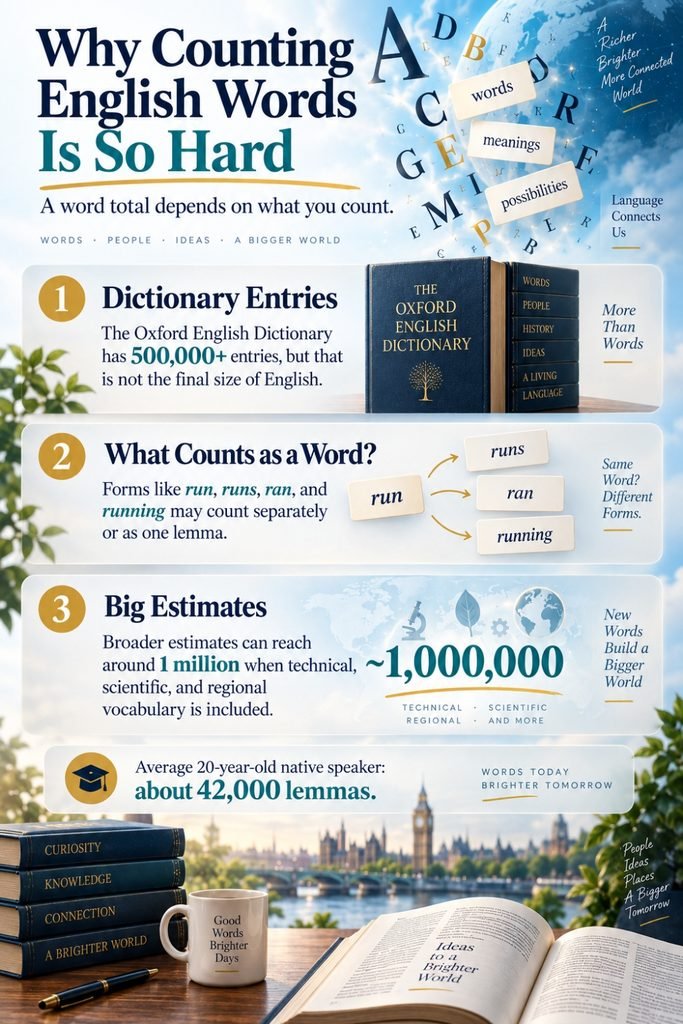
According to Oxford University Press, the OED now contains more than 500,000 entries supported by approximately 3.5 million quotations covering more than 1,000 years of English.
That still does not mean English has exactly 500,000 words.
The OED is a historical dictionary. Its purpose is to document English vocabulary and its development, not to declare the final size of the language.
Oxford Languages provides another useful comparison. Its English dictionary used by Google contains more than 350,000 words and phrases from English varieties around the world.
Oxford also provides word-list datasets containing more than 480,000 words, including main forms, variants, inflected forms, compounds, and multiword expressions.
These different totals demonstrate the central problem: the answer changes depending on what we decide to count.
Why Is It So Difficult to Count English Words?
Counting words sounds as though it should be as simple as counting entries in a database. Linguistically, it is much more complicated.
Consider the verb run.
We also have runs, running, and ran. Are those four different English words, or four grammatical forms of one word?
Linguists often use a unit called a lemma to solve this problem. A lemma generally groups related grammatical forms beneath a basic dictionary form.
Under that system, run, runs, running, and ran may belong to the same vocabulary item rather than being counted separately.
But even that does not solve everything.
Merriam-Webster’s explanation of English word counts points to another complication: different words can share exactly the same spelling.
Its unabridged dictionary, for example, contains multiple distinct entries for words such as post, representing different meanings, origins, or grammatical uses.
Researchers then have to decide whether identical spellings count once or several times.
English also contains expressions such as port of call. The expression functions as a recognized lexical unit, yet it consists of three separate written words.
Whether such expressions count toward the total can dramatically affect the final number.
Dictionaries Do Not Contain Every English Word
It is tempting to assume that adding up everything in the biggest dictionary would solve the question. Dictionaries do not work that way.
Different dictionaries have different purposes.
A learner’s dictionary may concentrate on vocabulary people need for everyday communication. A historical dictionary records words from earlier periods as well as modern English.
A medical or scientific dictionary may contain thousands of highly specialized terms that an ordinary general dictionary does not need.
According to Merriam-Webster, Webster’s Third New International Dictionary, together with its 1993 addenda, contains around 470,000 entries.
Merriam-Webster also explains that scientific and chemical terminology can greatly increase estimates of the total English vocabulary.
Dictionary size therefore tells us how much vocabulary that particular dictionary records, not the exact size of English itself.
Is It True That English Has More Than One Million Words?
You will often see the claim that English has one million words or more.
It is possible to produce a total around that size if the definition is broad enough. Merriam-Webster acknowledges that English vocabulary has been estimated at roughly one million words, especially when numerous scientific and chemical terms are included.
However, the organization also notes that linguists treat such a figure cautiously because the method of counting can change the total by hundreds of thousands.
This distinction matters.
There is no official organization registering every English word at the moment it is created.
There is also no universal database containing every dialect word, scientific term, historical form, slang expression, compound, and new coinage.
Claims about a precise “millionth English word” should therefore be treated skeptically.
Linguists have criticized attempts to identify an exact millionth word because the underlying definition of a word is too flexible for such precision.
One detailed discussion of the issue appears on the University of Pennsylvania’s Language Log.
It is safer to say that English may contain around a million lexical items under very broad counting methods, but no authoritative exact total exists.
Is the English Language Still Growing?
Absolutely.
New technology, science, entertainment, social media, politics, and cultural exchange continually create vocabulary or give existing words new meanings.
The Oxford English Dictionary is regularly updated. In its June 2026 OED update, Oxford added more than 900 new words, phrases, and senses.
Examples included terms such as floordrobe, humblebrag, and life hack.
That does not mean all those expressions were invented during the same few months.
Dictionaries normally wait for evidence that a word or meaning has established meaningful use before adding it.
This is an important difference between a word being created and a word entering a dictionary.
Oxford Languages also continually updates its datasets as language changes. Its dictionary update information shows how new headwords, phrases, senses, and revisions are added over time.
English is also spoken across many countries and communities.
Oxford Languages’ English dictionary documents vocabulary from varieties of English used around the world, including British, American, Australian, Canadian, Indian, Irish, Nigerian, South African, and Philippine English.
That global use continually broadens the vocabulary available to English speakers.
How Many English Words Does an Average Person Know?
The number of words in the entire language is very different from the number an individual person knows.
A major peer-reviewed study by Marc Brysbaert and colleagues investigated vocabulary knowledge using a large-scale experiment.
In the study, “How Many Words Do We Know?”, researchers estimated that an average 20-year-old native speaker of American English knows about 42,000 lemmas, along with approximately 4,200 non-transparent multiword expressions.
The study found considerable variation.
Vocabulary estimates ranged from roughly 27,000 lemmas for the lowest 5% of participants to about 52,000 for the highest 5%.
Researchers also estimated that between ages 20 and 60, an average person acquires approximately 6,000 additional lemmas.
Notice that the study counts lemmas, not every possible inflected form as a separate word.
That distinction is one reason vocabulary estimates from different studies can look very different even when both are based on serious research.
What Is a Lemma?
A lemma is essentially the basic dictionary form used to group related versions of a word.
For example:
walk, walks, walked, and walking can all be treated as forms of the lemma walk.
This method prevents researchers from artificially increasing vocabulary totals simply because English words can change according to tense, number, or grammatical function.
However, some researchers use another unit known as a word family.
A word family may group a base word together with several closely related forms created through prefixes or suffixes.
For example, develop, developer, development, and developing may be connected within the same broader family depending on the counting system being used.
This is another reason questions such as “How many English words do you know?” need a definition before they can have a meaningful numerical answer.
How Many Words Do You Actually Need to Know?
Thankfully, nobody needs to learn half a million words to communicate effectively in English.
Vocabulary is extremely uneven in frequency. A relatively small group of common words appears repeatedly in ordinary conversations and texts, while tens of thousands of specialized words are encountered only occasionally.
Research discussed by Cambridge University Press suggests that knowledge of roughly 8,000 to 9,000 word families can provide the high level of vocabulary coverage needed for understanding many kinds of English texts.
That helps explain why fluent speakers can communicate comfortably while knowing only a fraction of the vocabulary documented across English as a whole.
A doctor, programmer, lawyer, mechanic, botanist, and musician may also know thousands of specialized terms that rarely appear in another person’s daily life.
Vocabulary size is therefore not simply about knowing “all English words.” It reflects what people read, study, watch, discuss, and do professionally.
Does English Have More Words Than Other Languages?
This is another difficult comparison.
Simply comparing dictionary sizes does not prove that one language has more words than another because dictionaries use different editorial standards and languages build words differently.
Some languages create new forms by adding endings to existing words. Others rely heavily on compounds.
English freely borrows vocabulary from other languages and also creates new compounds and specialized terms.
That makes direct word-count comparisons unreliable.
A dictionary with more entries may simply count compounds, inflections, regional terms, or historical forms differently from another dictionary.
For that reason, claims that English is definitively “the language with the most words” should be treated cautiously unless the comparison clearly explains its methodology.
Why Does English Have Such a Large Vocabulary?
English developed through centuries of contact with other languages.
Its basic Germanic vocabulary was heavily influenced by Norse, French, Latin, Greek, and many other languages.
Modern English continues borrowing words whenever speakers encounter useful names, foods, technologies, cultural ideas, scientific concepts, or expressions from elsewhere.
English is also highly productive.
Speakers can create compounds such as smartphone, website, or livestream, while prefixes and suffixes can create additional related words.
Scientific fields add another enormous layer of vocabulary. Medicine, chemistry, biology, computing, engineering, law, finance, and dozens of other disciplines continuously produce specialized terminology.
Meanwhile, slang and internet culture can spread new expressions across millions of speakers extremely quickly.
All of these processes make English vocabulary difficult to freeze into a single permanent number.
So, How Many Words Are in the English Language?
There is no exact number of words in the English language.
Major English dictionaries document somewhere in the hundreds of thousands of entries.
The Oxford English Dictionary contains more than 500,000 entries, while other Oxford datasets contain hundreds of thousands of words, variants, phrases, and related forms.
Broader estimates of the entire English vocabulary can reach roughly one million lexical items when technical, scientific, historical, regional, and specialized forms are included.
However, the most accurate answer is not a single number.
English has hundreds of thousands of well-documented words and potentially around a million or more lexical items under broader definitions, but nobody can produce a definitive total.
English keeps borrowing, inventing, combining, adapting, and redefining vocabulary.
By the time someone finished creating a perfectly complete list, the language would already have changed.